
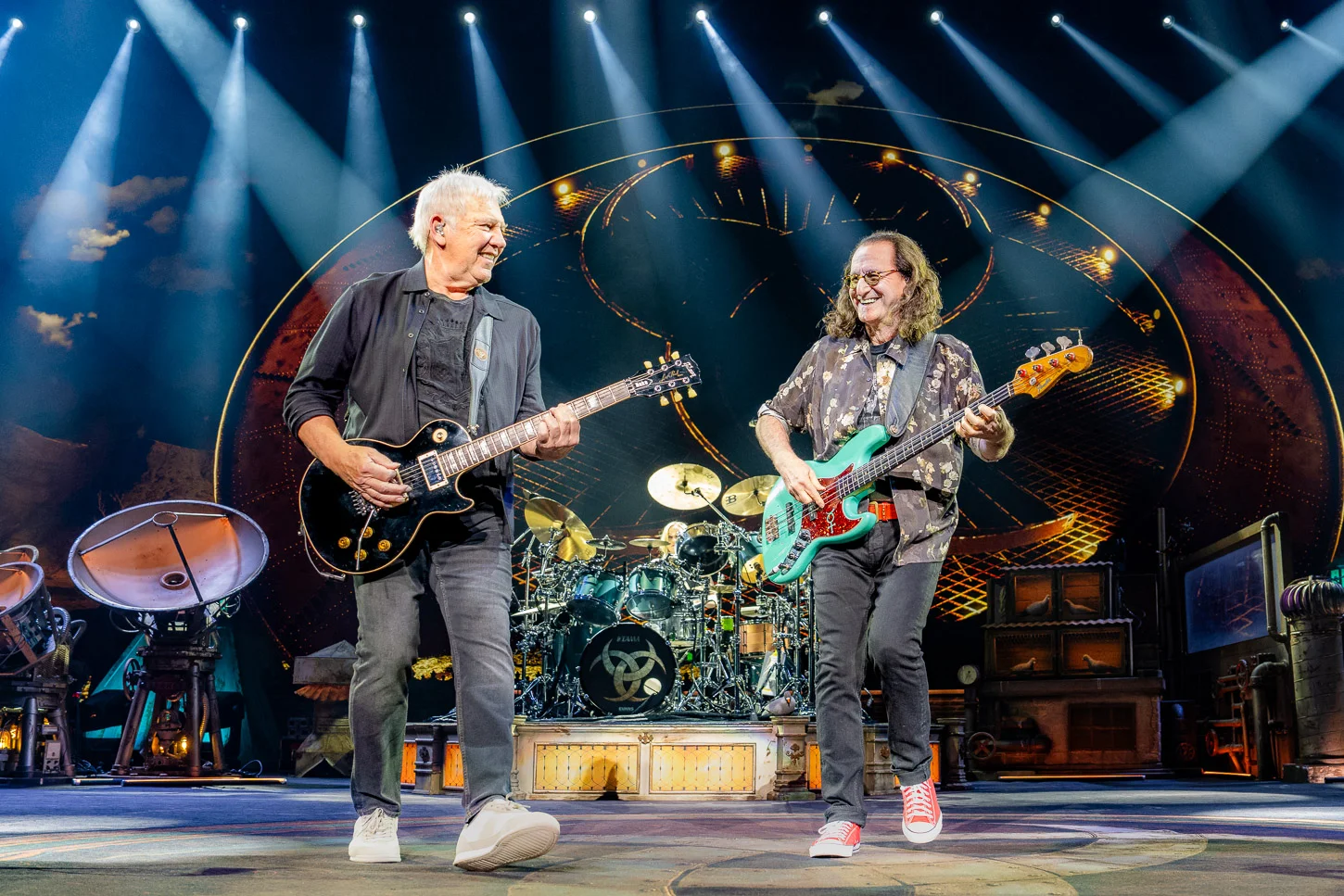
Rocket Arena, Cleveland, Ohio – September 19, 2026
“It felt special. It felt like an honor, playing with those drummers. Alex and I had been afraid of our own music. We had put our music in a box, and left it as a relic of the past. And by playing them, we realized that we have 50 years, and a body of music that is still alive.”
-Geddy Lee, from Neil Peart: No One’s Disciple (2026)
I’m no good at goodbyes. The facts bear this out, as do a select collection of bittersweet memories that, whenever I reminisce, always seems annoyingly close at hand. I tend to be too much in my own head, perhaps, not enough in the moment, as if contemplating the enormity of soldiering on without whom or whatever I’m losing swallows up any net positive, any chance to display even minimal gratitude. Canadian power-prog pioneers Rush have been my favorite band for well over half my life, and (quick finger math) about three quarters of it as a dedicated music fan. Their music means the world to me, and I struggle to recall a time when it didn’t. My situation is hardly unique, which provides a strange comfort, even and especially in the face of their absence. Rush simply endures. Like most fans of my vintage and intensity, I last saw Rush on 2015’s triumphant “R40” tour, which would sadly prove to be their final outing as the classic trio – bassist Geddy Lee, guitarist Alex Lifeson, and dearly departed drummer Neil Peart – that stoked so many musical fires and provided such rich and rewarding companionship throughout the 1970s, ‘80s, ‘90s, and 2000s. It was an open secret, never commented upon publicly, that Rush was in all likelihood finished as a forward momentum-generating entity at the end of this particular road. The band sounded as good that last night in Columbus as it ever had. Predictably, I treated the occasion like a wake.
It’s been a winding, arduous trek getting from that place to this, for me and other fans of my ilk – and, judging by the sold out Rocket Arena visible whenever the lights came up or swept the crowd in a particularly dramatic flourish, we are legion, ticket prices be damned – but especially for Alex Lifeson and Geddy Lee, childhood friends/conspirators who founded Rush in 1969 and occupied its center stage forever after. Before we flash forward eleven years to their most unlikely and luminous return to the limelight – one I doubted would happen right up until the first strains of “Xanadu” seeped out of the darkness – I should probably itemize everything noteworthy that’s happened in the interim, but I won’t. The long and short of it is that, yes, the chatter around Rush’s end proved prophetic, if sadly not for the ultimate reason we’d all imagined. Neil Peart passed away in December 2020, age 67, cutting short at almost five years to the official announcement date the retirement he had so plainly coveted throughout Rush’s numerous twilight runs – Time Machine, Clockwork Angels, and, finally, poignantly, R40. I was present for at least one date on each of those tours and can report zero perceived degradation of either skill or passion on anyone’s part. This was a point of pride to Neil, since, for a drumming legend nicknamed “The Professor”, he was actually a lifelong student, forever dreading the hypothetical day he couldn’t live up to his own stratospheric standards.
Thankfully, that day never came, which is at least some solace to those Neil left behind on both sides of the stage. I still remember crying upon receiving the shocking news of my musical idol’s death, and flooding the jukebox at a local watering hole with Rush songs during happy hour that night. I’ve thought about or listened to Neil Peart almost every day since, such is the reach and resonance of his art. We all mourn in our own way. Geddy started writing highly accomplished books on his various passions, and, eventually, his own fascinating effing life. Alex founded the challenging and acclaimed Envy of None project among a number of other guest collaborations. Under a barrage of inevitable questions that turned seemingly every journalist or passerby into a needling fanboy, the two lived with keeping Neil’s condition secret for years. Then, when he was gone, they had to process not just the shattering loss of a friend but the presumed end of their life’s work. For over a decade, Rush existed only in our headphones, speakers, screens, and memories. Apart from one-off appearances at special events, at which they observed the Led Zeppelin high profile guest drummer rule, there was no reason to think they would ever again be a touring entity. The decision to play again full-time, with the able assistance of German underground jazz-fusion powerhouse Anika Nilles, was, I later learned, born organically after much deliberation and care. For the longest time, I was mightily conflicted.
I present this rambling preamble not to pad my stats or belabor some point, but because I feel it crucial that the scene into which I walked at Rocket Arena be properly contextualized. All I can talk about with any authenticity is my own experience. That, after all, is ostensibly what you don’t pay for when reading this site. Neil Peart was, and is, my musical North Star. His ghost inhabits this story without quite haunting it, or at the very least enlivens its margins. I’ll never stop missing him, but I love Rush too. After years of hope that I might somehow be lucky enough to one day be gifted a surprise standalone studio album or some far-flung two-set destination wedding party in a far more interesting city than mine, something worth traveling for, Neil’s passing crushed those dreams definitively. I settled into an altogether colder new reality where it was now my job alone – never mind the millions of other fans worldwide similarly burdened – to keep the band’s spirit alive. Then, a truly remarkable thing happened. With minimal fanfare or advance warning, the “Fifty-Something” tour was announced, a modest series of two-night mini-residencies across North America that at once reassembled the professional and amateur online press like the Avengers during Endgame to breathlessly ponder and expound upon a future that was suddenly no longer a fantasy at all, and the unknown quantity Geddy and Alex had tasked with succeeding arguably the most irreplaceable rock drummer of all time.
I did not arrive at Rocket Arena in the highest of spirits, or even at my assigned seat until the reconstituted quartet – featuring not just Nilles behind the kit but the talented Loren Gold floating amidst a bank of keyboards – was already a few songs in. It had not been a drive to remember. A half-hour traffic jam leaving town eviscerated any time cushion I’d counted on, ensuring a nonstop white knuckle ride north to an off-site prepaid parking lot. After I arrived on the dot at the posted showtime followed a perplexed and increasingly desperate twenty-minute hike down the otherwise convenient walkway connecting Cleveland’s Tower City Mall with two major sports venues in (technically) close proximity. Luckily, Rush, as always, sympathized, and kicked off the evening with one of their signature whimsical video intros engineered to lighten the mood whilst allowing late arrivals to find their seats. I don’t have a clue what said intro showed – I’m sure it was as self-deprecating and chuckle-worthy as ever, and well worth catching on YouTube eventually – but it lasted just long enough to assure my position in the curtained entryway with a handful of other stragglers before the music began in earnest. Almost immediately, the translucent videoboard obscuring the stage apron began to rise and epic opener “Xanadu” – one of the smattering of songs consistently played every night, and the only one save parting shot “Working Man” to always occupy the same position – first wafted and then washed over the rabid crowd.
Rush’s initial legend was built not just on the band’s steadfast refusal to play by the already calcifying rules of 1970s arena rock but its assertion and, crucially, demonstration that artistic satisfaction and commercial viability need not be mutually exclusive. When record companies demanded fealty through a procession of radio-friendly singles and uniformly compact distances between points A and B, then-adolescent Rush answered by roaring past those gatekeepers, unleashing alongside more traditional toe-tappers a torrent of equally literate and muscular nine, ten, twelve, and, eventually, twenty-minute centerpiece songs of dizzying musicality and fearless compositional complexity, until, finally, with the dystopian sci-fi opus “2112”, they amazingly won, and never had to play the recording industry’s game again. Alternately roughspun and regal, “Xanadu” has never quite been my favorite member of Rush’s longplayer repertory company, but it has ample charms. From the second “Fifty-Something’s” opening night setlist was revealed and fan footage from Los Angeles began making the YouTube rounds, I remember thinking it a delightfully unconventional choice, especially once the nightly appearances began. We didn’t get this far by following expectations, it seemed to say…should we start now? You always trusted us to take you on a journey, so here goes. No calculated leadoff feel good “hit” was necessary to get the crowd humming, now or ever. We’d waited for this moment every bit as long as Geddy and Alex had, after all, pre-heated with anticipation until some among us were practically molten. The emotion I most felt was relief.
An emotion that, following eleven minutes of gaining bearings and stretching its legs, melted into another (surprise), then another (happiness), several more on top of that (joy, gratitude, serenity even), then seemingly all of them at once (news at 11). “Xanadu” yielded to the hopeful, nomadic “Dreamline”, one of not only my favorite Rush songs of the 1990s but “track one/side ones” ever, even for a band that so often deployed its heavy artillery in opening salvos. Geddy paused to greet the crowd and frame the evening as a special occasion, a celebration of music and the proper tribute to Neil they’d never gotten to mount in the grips of the COVID-19 pandemic. He introduced Loren Gold and Anika Nilles, calling her “marvelous” and more or less leaving it at that, counting on her playing to handle the affirmation for any remaining skeptics. Another in that storied tradition of heavy leadoff hitters followed in Signals’ beloved tone-setter “Subdivisions”, Neil’s sympathetic, synth-heavy ode to the crushing navigational complexities of suburban high school life. Anika colored inside the lines but otherwise did what she pleased with one of Neil’s most famous and intricate parts – one I basically know inside out after years of drilling it – and acquitted herself nicely.* Having been conditioned by The Professor himself to eschew flailing histrionics in air drumming of the sort practiced by at least half the Cleveland audience, instead emphasizing album-perfect precision, I’m the one who looked foolish mucking up a note or five, promise.
*This proved to be the model for how the show would go overall, as Anika achieved the tricky feat of both honoring Neil through her playing and making each song somewhat her own. She didn’t push too hard as a rule or noticeably show off, though her considerable chops were on constant display given the source material being interpreted. Despite a couple of dextrous mini-runs purposely inserted into the odd track, there was no dedicated drum solo, because that was Neil’s thing and Anika is her own player. It was never that Neil wrote drum parts that defied duplication. He always wanted to challenge himself, and, in so doing, inspired drummers of every skill level to explore their own limits with a tip of the cap to their beloved Professor. Such mutual admiration is on delightful display in the superlative new Banger Films documentary “Neil Peart: No One’s Disciple”, in which an engaging meditation on Neil’s biography and philosophy is punctuated by an interstitial procession of drumming royalty (Tool’s Danny Carey, King Crimson’s Gavin Harrison, Chili Pepper Chad Smith, and Stewart [Freaking] Copeland of the Police) jamming with Geddy and Alex and expounding upon Peart’s abiding influence. The film’s coda, in which ‘Fifty-Something’ is first articulated, even features a welcome appearance from Anika Nilles, the goofy, unassuming, crazy talented prodigy who only took a single song for public consumption – as Rush v3.0 reintroduced itself by opening the 2026 Juno Awards ceremony with a surprise, and surprisingly triumphant, performance of “Finding My Way” – to transform from elephant in the room to another ace player in this new incarnation of rock’s preeminent ensemble.
“All the treasures | the gold and glory | It didn’t always feel that way |
I don’t regret it | I’ll never forget it | I wouldn’t trade tomorrow for today”
It was with the set’s most recent song that my evening made its first of two dramatic pivots. “Headlong Flight”, a stirring latter-day favorite that Geddy singled out as a prime example of how Neil’s to my mind always underrated lyrics had matured like fine wine, suggested that the distance between the funerary tinge of 2015 and tonight’s celebration was much shorter than traditional calendars might allow, and I just couldn’t help tearing up a little. I get misty sometimes listening to “Headlong Flight” on my computer at home, for heaven’s sake, so do lay off. No other Rush song feels more to me like Neil simply speaking, free of the literary pretensions that were often a feature of his early career or insightful humanist musings that characterized his later work, a double-edged yet unambiguous expression of nostalgia and appreciation for the primacy of the moment, and, especially, a life well lived. Suddenly I was right back in the teeth of the band’s swan song, though hopefully comporting myself with a little more grace this time around. Neil was gone all over again, though his spirit lingered and, eventually, shone through like mounting daybreak. Boasting similarly outstanding lyrics, 1991’s sneaky beautiful “Bravado” was presented next as an explicit remembrance complete with Oscar-worthy projected photo montage, and left me nearly beside myself. In this light, the driving, allegorical “Red Sector A”, written in memory of Geddy’s mother’s experiences during the holocaust, qualified as a palate cleanser. It was a heavy sequence.
Out of this existential moment, another pivot, as Loren Gold began conjuring a tune, familiar yet elusive, that I was certain I’d never heard right up to the point I realized otherwise. From dirgelike beginnings, it evolved into something more airy and ethereal before a slippery progression of just the right notes led me to realize I was in fact hearing a new stealth introduction to Hemispheres’ legendary instrumental “La Villa Strangiato”. As the song revealed itself, with Gold yielding to Alex’s intricate picking and Anika’s insistent hi-hat, buttressed by Geddy’s keyboard trills, any residual angst left my body at once and I felt not just in the moment but unequivocally happy. Subtitled “An Exercise in Self-Indulgence,” “La Villa Strangiato” is two minutes of ebb pursued down a back alley by seven+ minutes of flow, serious, playful, and colossal, the sound in 1978 of three prodigious players coming in real time to the extraordinary conclusion that their collective was beyond limits. Rush had pointedly set out to write a song too difficult to play, perversely succeeded, then mastered it anyway. In 2026, its status as a classic long since cemented, “Strangiato’s” power to stun has been fully supplanted by its capacity to delight, and from my seat in the lower upper bowl, I resolved that I and other fans were attending a celebration after all, of music I loved second to none, of musicians both living and departed I admired beyond measure, and of the shared history we all treasured.
Chief among this tour’s gentle thumbs to tradition is its nightly setlist. Culled from a base of forty songs that were no doubt chosen thoughtfully and over-rehearsed this summer, sets are deployed in rotating configurations that ensure no host city gets the same experience twice. Tinkering with the menu is something other road warrior favorites of mine like Clutch and The Dave Matthews Band have done as a matter of course their entire careers, and I always wished Rush would follow suit. Despite a discography twenty strong, the band’s practice had always been to curate a single exceptional setlist, polish it to a high shine, then deliver it to their adoring public sans deviation each and every night. As integral to Rush’s formula for success as Neil immediately proved, and as indispensable a partner as he became to Alex and Geddy, theirs is still the foundational relationship. With only the two of them left to make plans, they decided to expand their color palette, liberally applying a new mix of paints to the familiar old canvas guided only by their collective whim. The consummate road dog with jaw-dropping four-string skills, Geddy had never wanted to retire in the first place, while Alex, always a kindred spirit in that respect, used his sabbatical to recharge and battle lingering physical issues to a happy stalemate. With nothing now left to prove, except perhaps that they can still play like Rush at age 73, the old schoolmates seem hellbent on having maximum fun.
To that end, bouncing from one high to another, the first set continued apace, gaining momentum on the way to its climax. That end came with “The Spirit of Radio”, one of Rush’s highest-wattage crowd pleasers and quite possibly my favorite song in the entire catalog. It varies depending on my mood. Set two launched directly into a welcome full-album performance of 1981’s masterful Moving Pictures. Every soul who’s ever stayed up for a bolt of classic rock radio surely knows the paradigm-shifting “Tom Sawyer”, with its wall of guitar-augmented Moog keyboards, crisp, cryptic vocals, and Himalayan avalanche drum solo**. Its attendant hype to this day tends to suck up the oxygen perhaps better distributed among its peers, the gorgeous “Red Barchetta”, spectacular funk-rock instrumental “YYZ”, or plaintive “Limelight”, to say nothing of album cornerstone “The Camera Eye”, which I shamefully came to value later in my fandom because of an unfortunate if understandable tendency to reach the end of Moving Pictures side one and immediately rewind it to listen again instead of just, you know, flipping it over. Nor did the hits stop coming, in the form of lovely, thematically resonant “Time Stand Still” or preeminent lighter-worthy singalong “Closer to the Heart”. The band closed the set by revisiting their seminal 2112 album, playing the title track’s rollicking first two movements and throwing in “Grand Finale” for good measure. Some nights they play all twenty minutes across all seven parts, but not tonight. Simply too much ground to cover.
**Everybody by now has likely seen at least one of the thousands of YouTube shorts showing Anika nailing that cascading drum solo live. It truly was her audition reel in the PR battle for acceptance as Neil’s successor. I’m sure he would have been proud. And, as much as he instinctively loved drummers, and intelligent non-conformists, I think the two would’ve been fast friends besides.
This night felt like a classic Rush show in all but the most achingly obvious varsity ways. So many of the other nits one might be inclined to pick were either fully owned choices or utter technicalities. Truth be told, I stopped caring about those instantly in favor of this sublime music I’d told myself one thousand times I’d never experience live again. Still, branding aside, this wasn’t a Rush show exactly, even if it was so superb a facsimile as to trick both mind and heart into harmonious compliance. There’s certainly a long history of rock bands carrying on without prominent, even founding, members. Toss a boulder into any crowd of candidates and you’ll likely hit ten. We as Rush fans had ups and downs that mirrored the band’s, but were spoiled by forty years of stability. Now that Rush has, in the mere span of half a century, finally reached the same point so many other, lesser bands did in a comparative eye blink, a few interested parties, like me, remain mildly unsettled, if only because for so long they seemed like a fact of life. So, yeah, I’m no good at goodbyes, and I was fairly awful in 2015. But the biggest other difference between those two shows is how little this felt like goodbye at all. At worst, it’s farewell, a well-deserved chance for Geddy and Alex to again play this music we all love, and maybe, just maybe, symbolically exit stage left on their own terms.
And they do seem to be faring well. From humble beginnings, Rush’s “Fifty-Something” tour itinerary has become the musical equivalent of a living document, or perhaps a snowball rolling downhill, picking up additional dates as the nightly finished product demonstrates its strength and the players themselves, no longer new to the situation or one another, luxuriate in their hard-won confidence. The encore at Rocket Arena was a veritable victory lap, harkening back to the band’s humble beginnings as Zeppelin worshippers with peculiar potential with the muscular trifle (and drumming showcase) “By-Tor and the Snow Dog” and the thick, driving nightcap “Working Man”, the very song that first broke Rush through to a larger audience south of the border when a smitten Cleveland DJ began spreading the gospel over those fabled “invisible airwaves crackling with life”. Neil Peart was not yet a member of the band at that point, fifty-something years ago, with so many highs yet to come, nor was he tonight as the reconstituted Rush returned to its roots, but I felt his presence throughout. Geddy Lee and Alex Lifeson are lifers and lifelong friends. They miss their comrade and want to celebrate him. They love playing music and want to commune with the fans who have always been there with and for them. If this ends up being their final chapter, then what an end it is. And if not, well, I’ve stopped trying to ascribe expectations to their ongoing journey. It’s so much more fun that way.


